Oregon Parks and Recreation Department

Turning Community Insight Into Action for More Equitable Park Access

RDG was professional, courteous, knowledgeable and easy to communicate with. Their product was delivered timely and was very thoughtful. I would highly recommend RDG. Their integrity and attention to detail is remarkable.

Jason Resch, Communications Division Manager, Oregon Parks and Recreation

// Government + Public Sector

Equity & Access Initiative

The Oregon Parks and Recreation Department engaged RDG to answer a fundamental question: why were Oregon’s parks and outdoor spaces harder for some communities to access than for others?

That question shaped the entire project. Access was not evenly experienced across the state. For some Oregonians, parks felt familiar, reachable, and welcoming. For others, the barriers were more numerous, more persistent, and more consequential. Geography, transportation, cost, physical accessibility, cultural familiarity, safety, and prior experience all played a role, but not in the same way for every community.

The agency asked RDG to identify those barriers and produce a useful path forward. Through the work, RDG uncovered a more important insight: the barriers were not cleanly separated by group. Communities often described distinct experiences, but many of the underlying causes overlapped. What looked, at first glance, like a series of isolated issues turned out to be a smaller set of intersectional barriers shaping access across populations and regions.

  • 250+ State Parks
wide landscape photo of crater lake in Oregon

The Challenge

The challenge was not merely to collect feedback. It was to gather insight that was candid, specific, and strong enough to support action.

Many of the communities most affected by access barriers had good reason to be cautious. Some had participated in previous outreach efforts that felt superficial or unproductive. Others were wary that a project like this could become entangled in politics, internal resistance, or ideological opposition and ultimately be sidelined before anything changed. That skepticism was not abstract. It shaped whether people believed there was any value in speaking candidly at all.

A standard engagement process would not have produced meaningful results. To get beyond guarded, generalized responses, the project needed a structure that could build trust, support honest conversation, and surface the lived realities shaping how different communities experienced Oregon’s parks.

Our Approach

RDG designed and led a statewide engagement process built around direct, community-specific conversations.

Whenever possible, meetings were held face-to-face with organizations and representatives across the state. When in-person sessions were not feasible, discussions were conducted remotely. In every case, participants were given a clear explanation of the project, the purpose of the conversation, and how their input would inform the final recommendations. That clarity helped create the conditions for stronger participation and more honest dialogue.

Just as important, RDG chose not to collapse multiple constituencies into broad, catch-all focus groups. That decision was deliberate. Too much equity work treats communities as interchangeable, flattening distinct identities and experiences into generic categories that obscure more than they reveal. RDG recognized that if the work was going to be credible, each group needed space to speak for itself, in its own terms, about the specific conditions shaping access. Participants included representatives from BIPOC communities, immigrant communities, LGBTQ communities, disabled communities, neurodivergent communities, low-income Oregonians, outdoors organizations, and parents of disabled youth, among others.

Each meeting began with a consistent set of core questions to preserve rigor across the process, while leaving room to follow the most important threads within each discussion. That balance of structure and flexibility made it possible to gather comparable information across a wide range of participants without reducing their experiences to a reformatted framework.

All conversations were transcribed and analyzed in depth. RDG reviewed the material qualitatively and used thematic and keyword analysis to identify patterns across interviews. That made it possible to examine the findings on two levels: first, by understanding the distinct experience of each community, and second, by identifying the recurring issues that cut across groups.

That second level of analysis became one of the most important contributions of the work. Many barriers that initially appeared isolated turned out to reflect shared root causes. Challenges often understood as cultural or demographic were also shaped by transportation, economic constraints, unfamiliarity, intimidation, and prior experiences that affected whether park spaces felt welcoming and accessible. By separating symptoms from causes, RDG helped the agency see where intervention could have the broadest impact.


What RDG Delivered

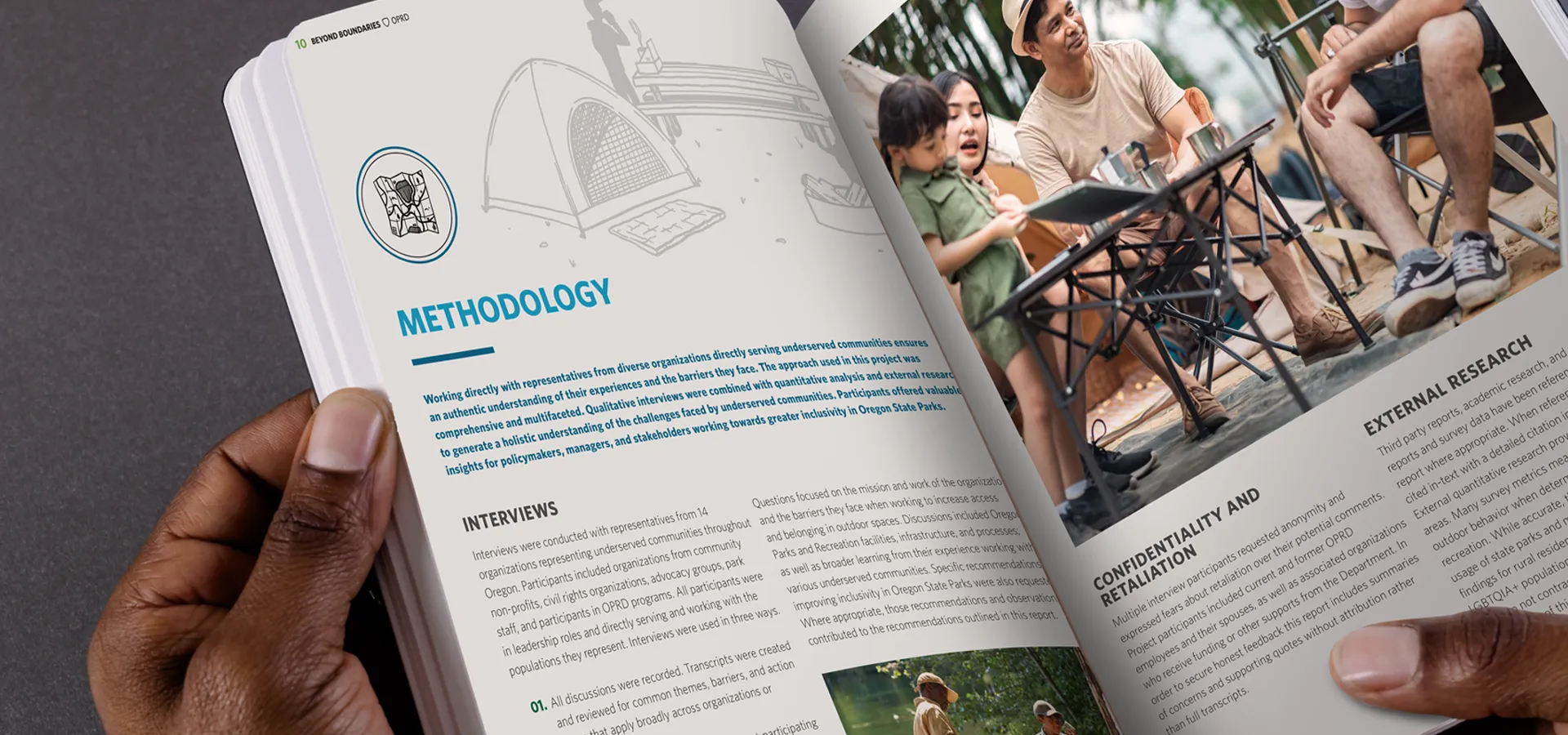
RDG’s primary deliverable was a comprehensive, action-oriented report designed to help the agency move from insight to implementation.

From the outset, the report was built not as a repository of findings, but as a decision-making tool. Its purpose was to synthesize a large and complex body of community input into a clear set of issues and a practical path forward.

The report was structured to do three things.

  • It documented the barriers identified across communities and explained how those barriers shaped people’s experience of Oregon’s parks and outdoor spaces.
  • It distilled those findings into a concise set of core issues, with particular attention to the intersectional barriers that appeared repeatedly across different populations.
  • It translated those findings into clear action steps and programmatic solutions the agency could use to improve access in a focused and measurable way.

That final step was central to the value of the work. The report did not stop at showing where the agency could act. It laid out what to do, where to prioritize, and how specific changes could be implemented in realistic ways. The recommendations were targeted, practical, and designed to create meaningful impact rather than symbolic movement.

View the Full Report

  • 22 Stakeholder Interviews
  • 14 Community Organizations
  • 10 Actionable Initiatives

Project Leadership

The project was directed by Seth Revoal, RDG’s co-owner and CEO, who led strategy, stakeholder engagement, interview facilitation, synthesis, and final recommendations. Seth brought both advanced academic training and applied research discipline to the work, drawing on formal study in marketing and brand strategy at Johns Hopkins and public relations strategy at Cornell University.

He also brought deep cultural awareness and fluency in diversity-related issues, shaped by his professional experience with DEI-centered initiatives, his cultural background, and RDG’s status as a Woman- and Minority-Owned firm. RDG does not approach equity issues as an outside observer trying to interpret lived experience at a distance. As a woman- and minority-owned firm, RDG brings forms of perspective, context, and lived understanding that many firms simply do not. The firm sees that as a real strength and a meaningful advantage in work that depends on trust, nuance, and credibility.

Ready to Deploy Solutions

One of the strongest aspects of the project was the way it turned community insight into realistic recommendations.

Because RDG analyzed the findings at both the group-specific and system-wide level, the team was able to identify a relatively concise set of interventions with the potential to improve access for multiple communities at once. Rather than producing a long list of disconnected suggestions, the work focused on foundational issues where change could create broader cross-community benefit.

That made the final report especially useful from a program and policy standpoint. It helped the agency understand which barriers were most consequential, which improvements were likely to produce the greatest impact, and how those improvements could be pursued in practical terms through program design, operational planning, and internal prioritization.

The value of the project was not only that it surfaced barriers. It clarified what to do about them.


View the Full Report

How RDG Turns Complexity Into Action

This project reflects RDG’s value as a strategic partner, not a transactional vendor.

Clients often begin with a request for a deliverable. What they actually need is a partner who can help define the real problem, understand the conditions shaping it, and produce work that leads to meaningful progress. That is how RDG approached this engagement.

The objective was never limited to documenting barriers to park access. It was to understand those barriers well enough to identify practical, high-value responses. That required trust-building, disciplined listening, rigorous synthesis, and a consistent focus on utility from the start.

It also reflects something fundamental about how RDG works. The firm brings an ethic of pragmatism that is often missing from complex institutional work. RDG is not interested in producing a report that sounds thoughtful but changes nothing. Its approach is to make difficult issues legible, actionable, and easier to address, even when the subject is politically sensitive or operationally complex.

That approach produced a stronger end product here. By creating a process that communities could trust, identifying the intersectional causes beneath a wide range of reported barriers, and converting those findings into realistic, actionable recommendations, RDG gave the agency something more valuable than a summary of concerns. It gave them a usable framework for action.

That combination of rigor, pragmatism, and applied judgment is characteristic of RDG’s work.

RDG Brands // Government + Public Sector

What can RDG do for you?

We’re here to find creative solutions, develop tested strategies and action plans that work, and then execute those strategies and plans for successful outcomes.

Find out